 I am happy with my Sunshine except…..I kept breaking threads. Even after adjusting all my tensions according to Todd Fletcher’s method, I still broke thread way too often. Finally a light bulb went off and I wondered if it had something to do with this machine not having a hopping foot. I went to my Pfaff and stitched a little to evaluate what the difference was between the two. It was clearly the hopping motion that I use to set a rhythm when I stitch.
I wrote Nancy at Sunshine 16 about acquiring a hopping foot and she said NOPE, don’t have one, can’t use one with this machine…no, no, no, no.
Since I rarely follow directions of any kind and have mostly made up my own rules, I decided to try to modify my Sunshine myself. Afterall, that is one reason I bought this machine, being able to work on it myself.
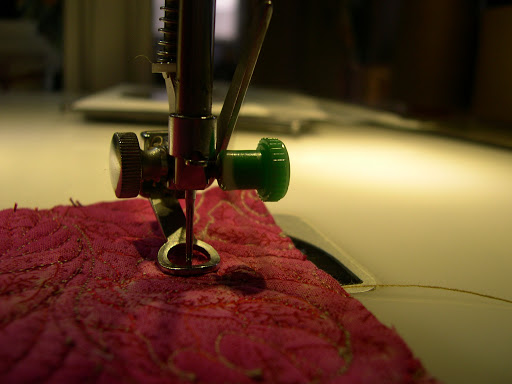
So I got out my antique tin lunch basket full of misc. vintage machine parts to see what I could find. The first thing I did was replace those fiddly little nylon screws with nice large thumb screws that my arthritic fingers could get hold of. You can see one holding the attachment on and the green one is the needle set screw.
Then I found a hopping foot that can be used for free motion quilting, embroidery or darning on vintage machines. I knew that arm was going to be critical for this to work. This was a low shank attachment but it didn’t matter since I can adjust the height of the shaft to allow for different thicknesses of batting and the bar has a spring on it to raise and lower the bar manually. It works perfectly! You can see in the photos the raised and the lowered position of the foot as the needle sews. I couldn’t be happier with this. It might be a little ‘in your face’ to the makers, but geesh….listen to your customers. This was not a hard fix at all.



 JP Dawes Contemporary Artist